What Is Pixel Pitch on an LED Video Wall?
Pixel pitch is the distance, measured in millimeters, between the centers of two neighboring pixels on an LED panel. A 1.9mm panel places its pixels 1.9 millimeters apart; a 3.9mm panel spaces them roughly twice as far. That one number drives how sharp the wall looks at a given distance, how large the image can feel in a given footprint, and a meaningful share of what an LED video wall rental costs. D24K Productions stocks walls from 1.9mm to 3.9mm and specs the right pitch for every build, in Philadelphia and nationwide.
The Simple Rule: Match Pitch to Viewing Distance
The working rule of thumb in production is about one meter, roughly three feet, of comfortable viewing distance per millimeter of pitch. Stand closer than that and the eye starts to resolve individual pixels; stand farther and the image reads as a single seamless picture. So a 1.9mm wall looks solid from about six feet away, a 2.6mm wall from about eight, and a 3.9mm wall from about twelve. The question that decides your pitch is not what is the best panel, it is where will the closest person stand.
What Each Pitch Range Is Built For
Fine Pitch, Around 1.9mmBoardrooms, broadcast sets, trade show booths, and any stage where guests walk right up to the wall. Holds crisp text and camera closeups at handshake distance.
Middle of the RangeThe workhorse zone for ballroom general sessions, galas, and corporate event AV. Sharp from the front tables, efficient on panel count for the size the back row needs.
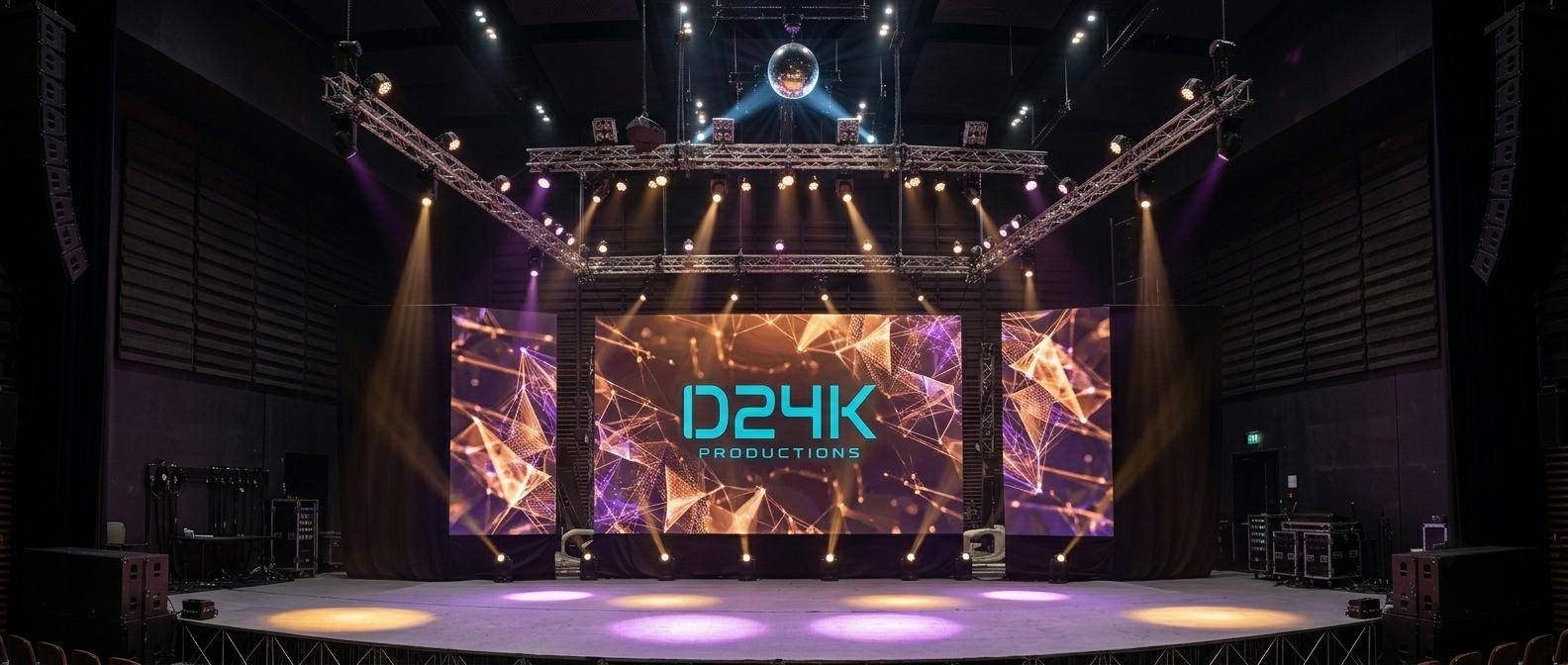
Wider Pitch, Up to 3.9mmConcert and festival backdrops, outdoor stages, and big-format walls viewed from a distance. At those distances the image is just as seamless, and the budget goes into size and brightness where it counts.
Pixel Pitch and Resolution Are Not the Same Thing
A TV has a fixed resolution label like 4K. An LED wall does not: its resolution is simply how many pixels the build adds up to, which depends on both the pitch and the physical size of the wall. A 10 foot wall at 2.6mm carries more pixels than the same wall at 3.9mm, but a bigger 3.9mm wall can carry more total pixels than a small 2.6mm one. Our video team scales and maps your content to the exact pixel count of the build through the wall processor, so slides, video, and camera feeds land pixel accurate. If the show runs playback, switching, or live camera on cue, a video engineer runs that; every wall also includes an LED tech on site in case anything goes wrong with the wall itself.
Is Finer Pitch Always Better?
No, and this is where budgets get wasted. Finer pitch costs more per square foot, so paying for 1.9mm sharpness that nobody stands close enough to see is money that should have gone into a larger or brighter wall. Outdoors the tradeoff tilts even harder: daylight shows are won by brightness and size, not by pitch the crowd can never resolve from fifty feet. The honest spec is the coarsest pitch your closest viewer will never notice, in the largest size the sightlines deserve. That is how we quote every wall, and it is why two walls of the same size can carry very different rental costs.
Indoors and Outdoors
Indoor walls live at the finer end of the range because audiences sit close and rooms are dim. Outdoor walls use high brightness, weather rated cabinets and usually a wider pitch, because the audience is farther away and sunlight is the real enemy. Flown walls and ground supported walls can take either, with rigging and ground support specced to the build. And because walls are modular, there is no fixed maximum size in either direction.
How D24K Specs the Right Pitch
Tell us five things through the quote form: the date, the venue, where the wall goes, what plays on it, and where the closest audience member will stand. We come back with wall dimensions, pitch, panel count, processing, and crew, itemized, typically within one business day. If a bright projector and screen would honestly serve the room better, we stock projection too and we will say so.
Common Questions
What does the millimeter number on an LED wall mean?
It is the pixel pitch: the distance in millimeters between the centers of two neighboring pixels. A 1.9mm wall packs its pixels closer together than a 3.9mm wall, so it holds a sharper image when viewers are close.
What pixel pitch do I need for a corporate ballroom?
For most ballroom general sessions, a pitch in the middle of the 1.9mm to 3.9mm range reads cleanly from the front tables to the back row. Tell us the room and we will spec the exact pitch from the closest seat.
Is 1.9mm always better than 3.9mm?
No. Finer pitch only pays off when the audience is close enough to see the difference. At festival distances a 3.9mm wall looks just as sharp, and the budget is better spent on a bigger, brighter wall.
How close can the audience be to an LED wall?
A common rule of thumb is about one meter, roughly three feet, of viewing distance per millimeter of pitch. A 2.6mm wall starts to look seamless from around eight feet; a 3.9mm wall from around twelve.
Can one wall mix different pixel pitches?
A single wall is built from panels of one pitch so the image stays uniform. Shows that want multiple surfaces, like a main wall plus side IMAG screens, can mix pitches across separate walls, and we spec each surface for its own viewing distance.